I saw lady apples today in the market. You know, those miniature yellow and red apples, about the size of a ping-pong ball. Every time I see them I am reminded of my grandmother. She loved those lady apples. I never buy them, but I always linger for a moment and remember her. My grandmother had a great influence on my life and I like to think that I resemble her - if not physically then in terms of certain traits and characteristics. I named my first daughter for her and I cherish the times when I daydream about her presence in my life.
My grandmother had one of those amazing life stories. Born in Russia (now it is Moldova) she was poor, persecuted and suffered a great deal of loss early in her life. When she was young her father owned a bookstore where famous philosophers and writers were known to hang out. But at an early age her mother died. When she was not yet a teenager her father and older brother came to America to make money and later send for them leaving his three daughters with their elderly grandmother. And as so many stories like this go, the grandmother died, World War I broke out and for many years my grandmother never heard from her father and brother. She and her younger sisters survived purely by their resourcefulness and will.
My grandmother had a striking sense of style and was a talented dressmaker. When she came to the US, she never worked in a sweat shop like many of her generation of immigrants to NYC. She worked on fine dresses, deftly able to hand roll a silk hem, or hand bead a dress bodice. She had amazing talent and an incredible sense of style. My grandmother lived with us when I was growing up from my tween years until I left for college. I spent many hours sitting with her and watching her work, talking, answering her inquiries about my day, my friends, my adventures.
Later in her life she started making exquisite life-like beaded flowers from tiny seed beads. She made orange and black poppies and fresh white daisies. Her hands were never idle - even when she sat and talked with you she was always folding her skirt fabric or apron or purse handle into different fan patterns. She could make something out of nothing. A gown from a piece of cloth. Fabulous embroidered table clothes from ordinary fabric and thread. And flowers from beads and wire.
My grandmother lived to be 96 years old. She was vibrant and with-it until her very last year. Even in her early 90s she had a great wardrobe - pant suits, dresses, blouses that she always “tweaked” in some way to express herself “just so”. Some days when I am working at my workbench, especially beading, I think of her. I think that maybe, just maybe, my work creating jewelry, stringing beads and working in patterns ties me back to her. I only hope that I possess some degree of her talent and style. I am grateful for her influence on my life and for the warm, well-worn memories that I have of her.

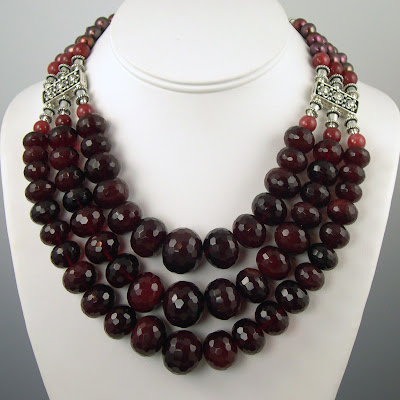
Layering necklaces is a technique that has been around for years and is still going strong. It is understandable as it allows you to vary your look, be creative and create custom looks. So next time you are trying to decide which necklace to wear, consider wearing them all. OK, not really, that would be overdoing it. But with some editing and experimentation you can accomplish some interesting looks.
On this Fall’s runways designers showcased layered and stacked jewelry, really piling it on. Nested bib-necklaces closely circling the neck and stacked bangles from wrist to elbow were most dominant.
Here are a few pointers to consider when layering up:
If you are uncertain, then look for necklaces that are already layered for you. And then, go ahead and pile it on!


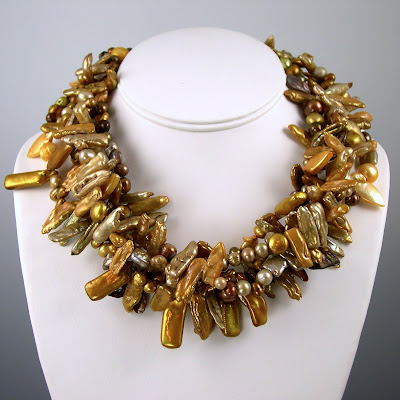
Pearls, the gem of Queens and the queen of gems. These little spherical gems, grown in oysters (or mussels in freshwater), are amazing accidents of nature. Pearls are the natural reaction of the oyster to an irritant. A genuine pearl (whether occurring naturally or cultured) starts with a grain of sand or a small foreign object that becomes lodged within the oyster. As a reaction, the oyster secretes a substance to cover the irritant and soften its edges, making it less irritating. This substance is called nacre. Over time, layer upon layer of nacre is applied to the irritant and thus a pearl is born. The more layers of nacre, the larger the pearl, the deeper the shine and lustre on the surface - the more beautiful the pearl!
Both naturally occurring and cultured pearls are genuine pearls (vs. imitation pearls which are man made beads of glass or other materials which are made to look like pearls). Natural pearls happen by accident in the oyster and are found by accident as well, making them rare and valuable. On the other hand cultured pearls are “farmed”. Oysters are suspended on racks in ponds, irritants are inserted, time passes while the oyster covers the irritant with layers of nacre, and then after a number of years the pearls are harvested. As a result of this human intervention cultured pearls are more plentiful. And that means that what used to be the exclusive purview of royalty and aristocrats is now more abundant and affordable.
The quality, size and shape of freshwater cultured pearls vary widely with the depth and quality of the nacre being the greatest determinant of quality. Some pearl farmers pull their crop too early (trying to cash in) before the nacre layers have gotten deep enough and hard enough. This impatience creates an inferior pearl. Oysters require two or more years to create a beautiful pearl.
Once pearls leave the belly of the oyster, they need people in order to remain beautiful. If they are left unworn in a vault or a drawer, they can turn yellow and brittle. But worn on the skin they become more luminescent. Stories abound through history of palace servants warming their mistress’s pearls by wearing them while doing chores during the day so that when the mistress donned them in the evening they would be warm and luminous.
Here are a few of the dimensions to consider when assessing pearls:
Size - ranges dramatically from small seed pearls to 20mm or larger.
Luster - is the depth and glow on the surface of a pearl. It is an indication of the amount of time the pearl spent in the oyster and the number of layers of nacre that the oyster applied to the pearl. Pearls should have a luminous glow and depth.
Shape - can vary greatly, especially with many of the newer cultured pearl processes. As for round pearls, one rarely finds a perfectly round pearl. In fact today many interesting shapes add value and interest, such as baroque, stick or coin shapes.
Surface - the surface of a pearl, while never without a blemish, should be smooth and without cracks or peeling. Again, some pearls have unique and interesting surface bumps and textures that can make them more valuable and interesting.
Color - natural pearls are white, cream or black. Otherwise, there is a huge industry of dyed and color treated pearls. Today a cultured pearl can be had in almost any shade of any color!


Firekites - AUTUMN STORY - chalk animation from Lucinda Schreiber on Vimeo.


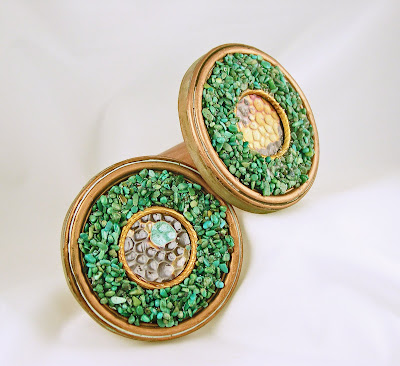
This last photo is of a pair of curtain tie-backs with a hammered copper center (don't they look like cufflinks?). These are the result of an exciting design collaboration with Lyn Hurst of Lyn Hurst Designs. In addition to the JuJu furniture jewelry pieces, JuJu is offering a coordinated collection of headboards, cornices and tie-backs -- all jewelry-inspired and gemstone encrusted!